
Mycelium growth mechanics are the biological and process conditions through which fungal networks bind agricultural residues into lightweight, moldable materials. By adjusting feedstock, moisture, temperature, particle size, and growth time, manufacturers can produce composites for packaging, insulation, acoustic panels, and selected non-load-bearing construction uses. The approach matters because the Food and Agriculture Organization estimates that roughly one-third of food produced for human consumption is lost or wasted, while crop residues also create disposal and emissions challenges. Research and commercial practice show promise, but performance depends on controlling fungal growth and validating each product for its intended use.
Growth mechanics define mycelium composite formation
Mycelium is the branching network of fungal hyphae. In a composite, those hyphae grow through a prepared plant-based substrate and physically bind its particles; the material is then dried or otherwise treated to stop growth and stabilize its shape. The resulting product is not simply “mushroom material”: it is a biofabricated composite whose behavior reflects both the fungal organism and the agricultural feedstock.
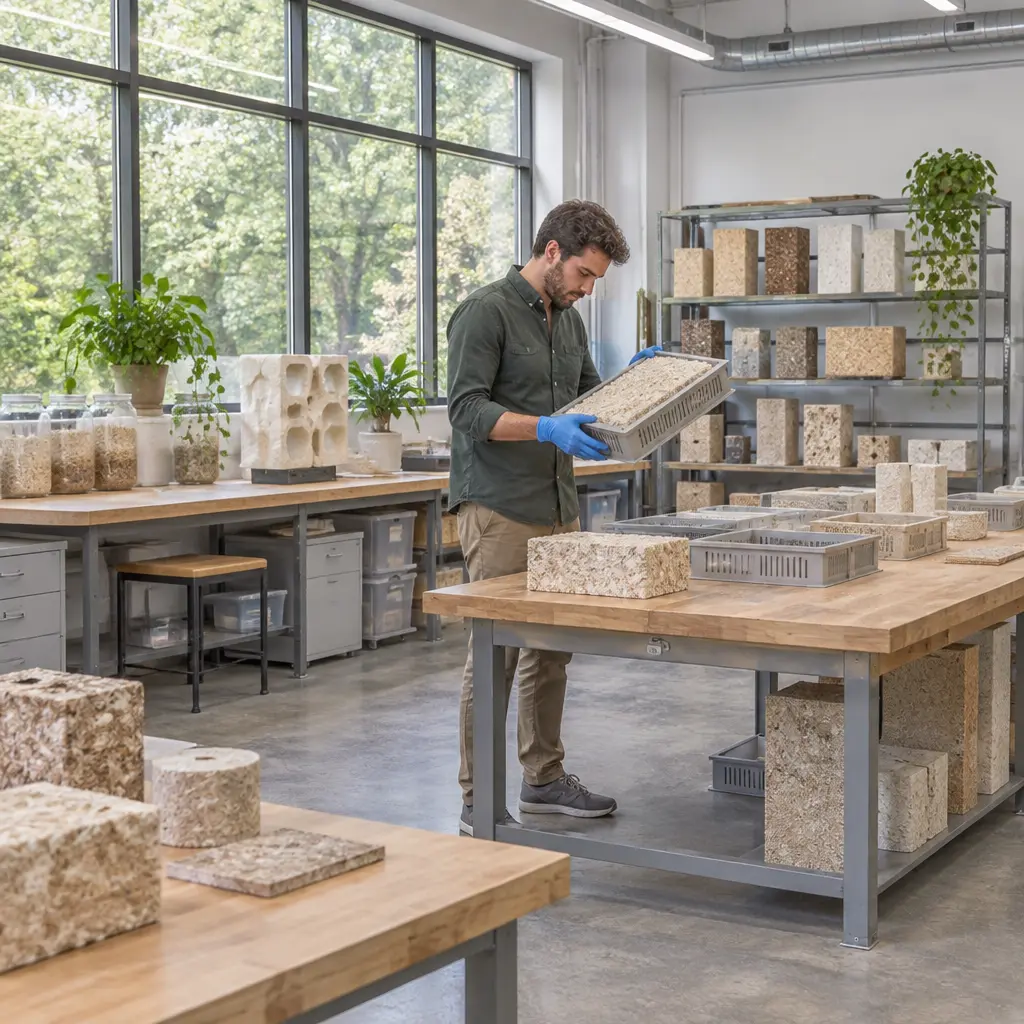
The review by Haneef and colleagues in Scientific Reports describes mycelium materials as composites formed when fungal hyphae colonize and bind lignocellulosic substrates. That definition highlights the core mechanism: a living growth phase converts loose residues into a connected structure. Typical feedstocks include straw, hemp hurds, sawdust, cotton waste, and other plant-derived by-products, although suitability varies with their chemistry and physical form.
Hyphal growth and particle binding
Hyphae extend through the substrate, branching and interweaving around its particles. Their networks provide mechanical entanglement, while fungal cell walls and extracellular compounds help create contact between neighboring particles. The exact contribution of each mechanism depends on species, substrate, and processing; therefore, a dense-looking growth surface alone does not establish a particular strength or durability.
Fungal species used in research and manufacturing include members of Ganoderma, Pleurotus, and Trametes. These are related but not interchangeable organisms: their growth rates, preferred nutrients, and interaction with a given residue can differ. Selecting a fungus is consequently a materials-design decision, not just a biological one.
Substrate chemistry and preparation
Agricultural residues contain different proportions of cellulose, hemicellulose, lignin, minerals, and soluble nutrients. Those components influence water retention, fungal access to nutrients, and the way particles pack into a mold. Chopped straw, for example, has a different fiber geometry from fine sawdust, so the same organism and recipe may produce different density and mechanical behavior.
Preparation commonly includes size reduction, moisture adjustment, and a contamination-control step such as pasteurization or sterilization. These operations help give the chosen fungus an opportunity to colonize the material before competing organisms do. A useful process record should therefore identify the residue source, particle-size range, moisture content, treatment, fungal strain, and growth conditions.
Process conditions govern composite quality
Once the feedstock is prepared, the growth environment determines how uniformly the mycelium colonizes it. Moisture, temperature, oxygen availability, packing density, and incubation time interact: changing one can alter growth and the final material. Published results cannot be transferred directly between products unless their test methods and formulations are comparable.
Moisture, temperature, and oxygen
Water supports fungal metabolism and enables hyphal expansion, but excessive moisture can restrict air movement and encourage contamination. Temperature must suit the selected strain, while oxygen must reach the growing network. This makes substrate depth and packing important: a tightly packed block may develop different internal conditions from a thin panel even when both use the same recipe.
There is no universal “best” moisture percentage or incubation temperature for all mycelium composites. Values reported in individual studies are tied to particular fungi, feedstocks, geometries, and measurement procedures. Manufacturers should establish validated operating windows for each formulation rather than treating a single laboratory recipe as a general standard.
Molding, growth time, and post-processing
In molded production, inoculated substrate is placed into a form that sets the product’s geometry while the hyphae grow through it. Growth duration affects colonization and can influence cohesion, but longer incubation is not automatically better: it also affects production time and may change the material’s structure. After growth, drying or heat treatment is used to halt biological activity; pressing, coating, or surface finishing may then be applied for particular uses.
The production sequence can be summarized as residue preparation, inoculation, controlled incubation, demolding, and growth termination. Each stage contributes to reproducibility. For example, uneven inoculation or inconsistent moisture can create weak regions, while different drying histories can change dimensions and measured performance.
Material performance determines suitable applications
Mycelium composites are often valued for low weight, moldability, and potential use of renewable residues. Their performance, however, is application-specific. A protective package, an acoustic panel, and a building insulation product face different requirements for compression, moisture exposure, fire behavior, emissions, and service life.
Packaging and cushioning
Protective packaging is among the most established applications: the composite can be grown to fit a product, potentially replacing some expanded-polystyrene packaging. Ecovative Design is a prominent commercial example, developing mycelium-based packaging and other materials from agricultural feedstocks. Such examples demonstrate manufacturing potential, but environmental comparisons still depend on the specific product, transport, energy use, coatings, and end-of-life route.
Packaging evaluation should include cushioning performance, moisture sensitivity, dimensional consistency, and whether the item can be reused, composted, or accepted by local waste systems. “Biobased” does not by itself guarantee home compostability or biodegradation under every disposal condition.
Insulation, acoustic panels, and interior products
Researchers and designers have investigated mycelium composites for thermal insulation, sound absorption, and interior components. Density, pore structure, thickness, and surface treatment influence these functions. These products may be promising where light weight and shaped manufacture matter, but building applications require testing against relevant standards for thermal conductivity, fire reaction, moisture, durability, and indoor emissions.
Architectural demonstrations and prototypes show how forms can be grown rather than machined from a solid block. They should be distinguished from certified structural products: a successful installation or exhibition is not evidence that a material is suitable for load-bearing construction or long-term exposure.
Strength, water resistance, and durability
Mechanical properties vary substantially with fungal strain, substrate, density, orientation, and finishing. Reviews by Jones and colleagues in Materials & Design and by Appels and colleagues in Materials & Design emphasize the breadth of formulations and the need to relate processing to measured properties. Comparisons are meaningful only when test geometry, conditioning, and methods are reported.
Moisture is a key durability concern because many untreated formulations can absorb water and lose performance under damp conditions. Coatings may improve resistance but can complicate biodegradation or recycling. Before describing a product as durable, manufacturers should report relevant aging, humidity, compression, fire, and biological-resistance tests for its intended service environment.
Agricultural-waste use offers benefits and trade-offs
Using crop residues can create value from materials that might otherwise be burned, left to decompose, or used in lower-value applications. The Food and Agriculture Organization has reported that about one-third of food produced for human consumption is lost or wasted; this figure concerns food loss and waste broadly, not the quantity of agricultural residue available for mycelium manufacturing. Residue supply is local and seasonal, and competing uses such as animal bedding, soil amendment, and bioenergy must also be considered.
Circularity and life-cycle assessment
A circularity claim depends on the full product system, not only on biological ingredients. Relevant factors include feedstock collection, drying and sterilization energy, cultivation conditions, additives, transport, product lifespan, and disposal. Life-cycle assessment is needed to compare a mycelium product fairly with alternatives such as foam, wood, or mineral insulation.
The European Commission’s work on life-cycle assessment provides a framework for examining environmental impacts across a product’s life. For mycelium materials, future assessments should disclose functional units and assumptions—for example, comparing packaging by the quantity of product protected, rather than by equal mass alone.
Scale-up, quality control, and standards
Scaling production requires consistent feedstock and repeatable biological growth. Agricultural residues vary between harvests and suppliers, while large molds can develop gradients in temperature, moisture, and oxygen. Quality control can combine process monitoring with batch tests for density, dimensions, compression, moisture response, and contamination.
Standards and regulatory requirements depend on the product category and market. Packaging, consumer goods, and building materials do not share one universal approval pathway. For construction in particular, fire performance, structural role, moisture durability, and indoor-air requirements must be established through appropriate testing before broad claims or deployment.
Conclusion: controlled growth turns residues into designed materials
Mycelium growth mechanics explain how fungal hyphae colonize and bind agricultural residues, while substrate preparation and cultivation conditions shape the resulting composite. The same biological platform can produce packaging, insulation concepts, and interior products, but each application requires its own performance evidence. Agricultural-waste use may support more circular material systems, yet environmental benefits depend on sourcing, manufacturing energy, durability, and end-of-life conditions.
Researchers and manufacturers can strengthen the field by publishing reproducible process data, testing products against their intended use, and conducting transparent life-cycle comparisons. Readers exploring the topic further should consult the peer-reviewed materials reviews and the FAO and European Commission resources listed below.
Sources: Food and Agriculture Organization of the United Nations, Global food losses and food waste—Extent, causes and prevention, https://www.fao.org/4/mb060e/mb060e00.htm; Haneef, M. et al., Advanced materials from fungal mycelium: fabrication and tuning of physical properties, Scientific Reports, 2017, https://doi.org/10.1038/srep41292; Jones, M. et al., Engineered mycelium composite construction materials from fungal biorefineries: A critical review, Materials & Design, 2020, https://doi.org/10.1016/j.matdes.2020.108397; Appels, F. V. W. et al., Fabrication factors influencing mechanical, moisture- and water-related properties of mycelium-based composites, Materials & Design, 2019, https://doi.org/10.1016/j.matdes.2019.107918; Ecovative Design, Mycelium Materials, https://www.ecovative.com/; European Commission, Environmental Footprint methods, https://environment.ec.europa.eu/topics/circular-economy/environmental-footprint-methods_en.
Related Posts
Bio-Based Mould Design Optimizing Geometry For Uniform Mycelial Growth Density
Mycelium-based materials are grown from fungal networks inside a controlled…

The Practical Appeal of Lightweight and Durable Mycelium Stools
Mycelium stools are seating products made from fungal root-like networks…

From Waste to Product How Mycelium Enables Circular Production
Mycelium—Circular Production Enabler: From Waste to Product Mycelium is the…