
Mushroom-based packaging is a protective material grown from fungal mycelium and agricultural by-products, and it can replace expanded polystyrene (EPS) foam in some applications when its performance, end-of-life route, and local composting conditions are suitable. The opportunity is significant: the U.S. Environmental Protection Agency estimates that containers and packaging made up about 28% of U.S. municipal solid waste generation in 2018, while EPS is lightweight but persistent and difficult to recycle in many communities. This review explains how mycelium packaging is made, compares its protection and environmental claims with EPS, examines what “home-compostable” does—and does not—mean, and outlines practical steps for businesses considering a switch.
Mycelium Packaging Defines the EPS Replacement Opportunity
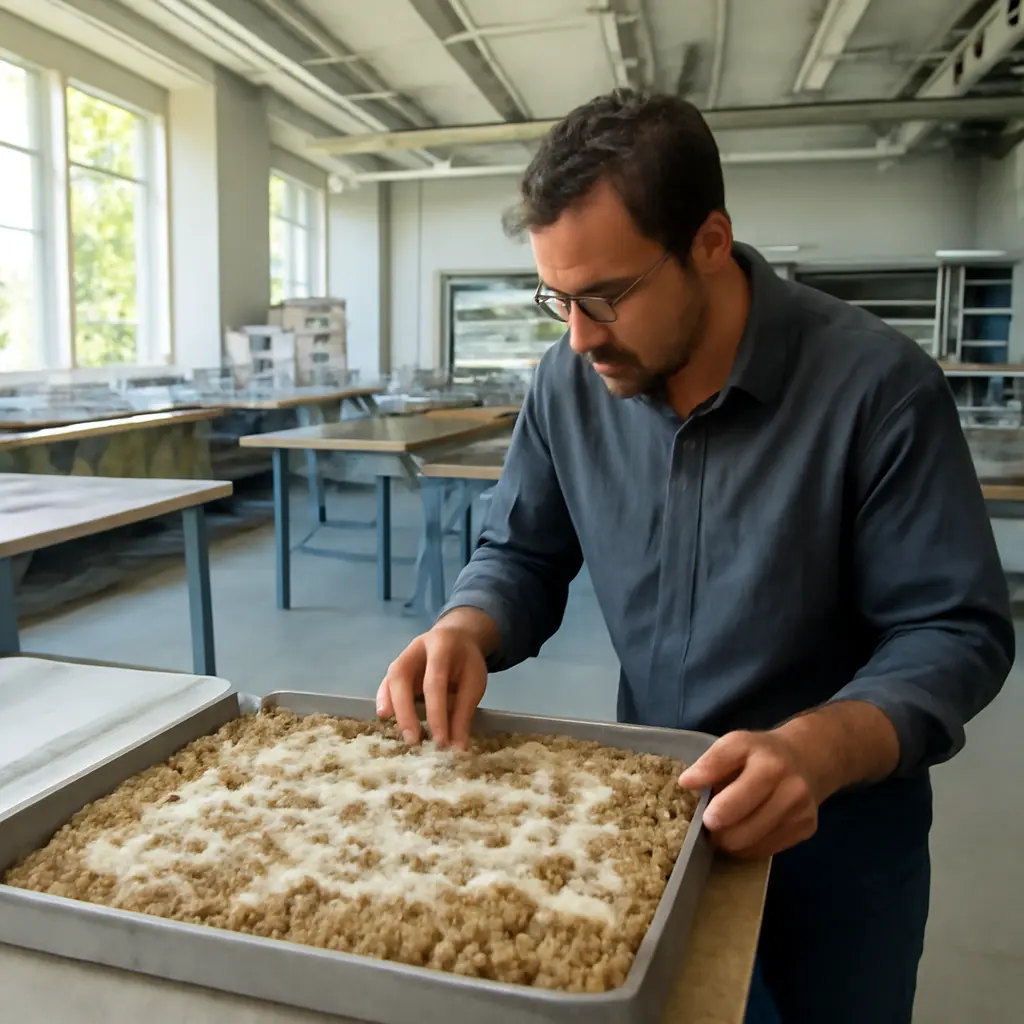
Mycelium packaging is a molded, porous composite in which the root-like network of a fungus binds plant-based particles into a shaped article. The U.S. Department of Agriculture’s Agricultural Research Service describes mycelium as the branching filament network fungi use to grow through and digest material. In packaging, manufacturers cultivate that network through substrates such as hemp hurd, agricultural residues, or other lignocellulosic feedstocks, then stop growth and dry the part.
EPS, by contrast, is a rigid foam made from expanded polystyrene. Its low weight and cushioning make it common in protective packaging, but its low density also makes collection and transport for recycling uneconomic in many places. EPA’s 2018 national materials data report approximately 14.5 million tons of plastics in containers and packaging generated in the United States; this category includes many plastic types, not EPS alone. The comparison therefore needs to be made product by product rather than by treating all packaging plastics as interchangeable.
The central claim is not that mushroom packaging is a universal substitute. Rather, it is a potential alternative for selected custom-fit protective inserts, corner blocks, and cushioning parts, particularly where a buyer can verify equivalent protection and provide a credible composting or other disposal pathway.
How mycelium composites are formed
A typical process mixes a fungal culture with prepared plant particles, fills a mold, and allows the mycelium to colonize and bind the particles. The molded part is then dried or otherwise treated to halt biological growth. The feedstock, fungal strain, particle size, mold geometry, moisture, and drying process all influence the final material’s density, strength, resilience, and water response. These variables mean that “mycelium packaging” describes a family of materials, not one standardized product with fixed performance.
Where mushroom packaging can replace EPS
The closest applications are molded protective pieces that need to hold an item in place or cushion it during shipping. Examples include corner protectors, end caps, bottle supports, and custom inserts for electronics, furniture, and appliances. A molded part can be designed around a product’s geometry, but it must still pass the same relevant drop, vibration, compression, and distribution tests as the EPS component it replaces.
Thin films, transparent clamshells, and applications requiring a very smooth surface or precise thermal insulation are not automatic matches. The material’s texture, moisture sensitivity, dimensional variation, and production scale may require redesign or a different substitute. This application boundary leads to the next question: whether a mycelium part protects goods as reliably as foam.
Protective Performance Determines Mycelium Packaging Suitability
Protective performance is the capacity of a package to limit product damage under expected handling, storage, and transport conditions. It is a system property: the material, part geometry, product weight, shipping configuration, and distribution route all matter. A sustainability comparison is only meaningful if the alternative prevents damage at least as well as the packaging it replaces.
Cushioning and shock response
EPS is widely used because it can absorb impact through compression and deformation. Mycelium composites can also provide cushioning, but their response depends on formulation and molding. Buyers should request measured data for the specific part, including compression behavior and impact protection, rather than relying on broad claims about the material category. ASTM D1596, a standard test method for dynamic shock cushioning, and distribution testing such as International Safe Transit Association procedures can help structure comparisons when applicable.
A useful qualification program tests the packaged product, not just a material coupon. A poorly fitted insert can allow movement even if its material is strong; conversely, a carefully designed molded part may protect well despite having different material properties from EPS.
Moisture, storage, and dimensional stability
Mycelium packaging is plant-based and porous, so exposure to humidity, liquid water, and long storage periods can affect its mass and mechanical behavior. EPS generally resists water absorption and retains its shape in ordinary wet conditions, although performance varies by product and exposure. For mycelium, buyers should evaluate moisture conditioning, warehouse humidity, transit duration, and whether a barrier or secondary wrap is needed. Any added coating must be included in the end-of-life assessment because it may change compostability.
Weight, volume, and shipping efficiency
Packaging mass affects freight, but volume and packing density can matter just as much. Molded mycelium parts may be bulkier or heavier than an equivalent foam design, depending on the application. A credible comparison therefore measures the complete packed shipment—including protective components—and considers damage rates and replacement shipments. The best material choice is the one that protects the product with the lowest verified overall burden, not necessarily the one with the most appealing feedstock story.
Home-Compostable Claims Require Specific Evidence
“Home-compostable” means that an item is intended to break down in a managed domestic composting environment, which is typically cooler and less controlled than an industrial composting facility. It does not mean that the item will disappear quickly in a landfill, in roadside litter, or in any backyard pile regardless of conditions. Temperature, moisture, oxygen, particle size, and the composting period affect decomposition.
The U.S. Federal Trade Commission’s Green Guides caution that unqualified degradable claims can mislead consumers when an item will not completely break down within a reasonably short period after customary disposal. For compostability claims, the FTC also advises that marketers should substantiate the claim and disclose when appropriate facilities are not available to a substantial majority of consumers. These principles make clear that “natural” or “plant-based” is not, by itself, proof of home compostability.
Home composting versus industrial composting
Industrial composting facilities can control temperature, aeration, and moisture at levels that household piles may not sustain. Standards and certification programs distinguish conditions and test requirements; for example, the European standard EN 13432 addresses packaging recoverable through industrial composting and biodegradation, rather than establishing that a product is suitable for every home compost system. Buyers should check the exact certification scope and avoid treating an industrial-compostability certificate as proof of home-compostability.
A product-specific home-compost claim should be supported by relevant testing or certification, clear disposal instructions, and evidence that coatings, inks, adhesives, and labels do not undermine the claim. If testing covers only the uncoated base material, the finished package may not share the same end-of-life properties.
Composting conditions and realistic outcomes
A mycelium part may be suitable for composting under appropriate conditions, but decomposition time cannot be inferred from the fact that fungi helped create it. The finished material has been dried, may contain different feedstocks, and may include additives. Home compost systems also vary substantially. Consumers should follow the manufacturer’s instructions and local guidance, and businesses should avoid promising a specific breakdown time unless it is supported by testing under stated conditions.
This distinction matters because compostability is an end-of-life property, while sustainability is a broader life-cycle question. A compostable item can still have environmental costs from cultivation, energy use, transport, or product damage; an EPS item may have a recovery route in some locations. The next step is to compare the whole system rather than one disposal label.
Life-Cycle Evidence Shapes the Sustainability Comparison
Life-cycle assessment (LCA) evaluates potential environmental impacts across defined stages, such as raw-material sourcing, manufacturing, transport, use, and end of life. ISO 14040 and ISO 14044 set principles and requirements for LCA studies. A fair comparison between EPS and mycelium packaging needs the same functional unit—for example, protection of one specified product through a defined distribution route—and consistent assumptions about damage, reuse, recycling, and composting.
Feedstock and manufacturing impacts
Mycelium packaging can use agricultural by-products, potentially giving low-value residues a productive use. However, the feedstock still has collection, preparation, and transport impacts, and the fungal growth and drying stages consume resources. The amount and type of energy used to control production and remove moisture can materially influence results. “Made from agricultural waste” is therefore relevant information, but it does not by itself establish a lower carbon footprint.
EPS relies on fossil-based polystyrene and an expansion process, while mycelium products may use renewable or residual inputs. A robust LCA should disclose data quality, geographic context, energy mix, allocation of impacts to by-products, and whether carbon storage or biogenic carbon assumptions are included.
End-of-life routes and local infrastructure
A theoretical composting route only delivers value if people can use it and the item is accepted by the relevant system. Some municipalities do not collect food scraps or compostable packaging, and some composters exclude packaging even when certified. Similarly, EPS recycling availability varies by location and collection program. EPA’s national data show that packaging is a major waste stream, but national totals do not reveal whether a particular household has access to a suitable local service.
Businesses should identify the disposal route in the markets where the product is sold, test packaging labels with local program rules, and avoid directing consumers to compost a product where that route is unavailable or prohibited. Where home composting is the intended route, the claim should be clear about suitable conditions and any components that must be removed.
Product damage as an environmental factor
Packaging prevents loss and damage, and replacing it with a material that increases breakage can erase environmental gains. An LCA should include product loss or a justified proxy when damage rates differ. For high-impact goods such as electronics or appliances, the material and manufacturing embodied in the protected product may outweigh the packaging impact, making reliable protection essential. Companies should compare total outcomes per safely delivered item, not merely emissions per kilogram of packaging.
Commercial Adoption Depends on Design and Verification
Commercial adoption means integrating mycelium packaging into a product’s engineering, sourcing, logistics, and end-of-life systems. Established suppliers, including Ecovative and its manufacturing partners, have marketed molded mycelium protective packaging for applications such as consumer goods and electronics. Such deployments demonstrate that production is commercially possible; they do not prove that every design, location, or product category will achieve the same cost or environmental result.
Qualification and procurement checklist
Before replacing EPS, a procurement team should create a specification that connects material claims to measurable requirements. A practical evaluation includes:
- Define the product, shipment route, expected storage conditions, and required protection.
- Run package-level impact, vibration, compression, and handling tests appropriate to the distribution system.
- Measure component mass, volume, fit, production consistency, and any effect on freight or assembly.
- Obtain documentation for feedstocks, additives, coatings, manufacturing energy, and quality controls.
- Verify compostability claims for the finished item and confirm that the relevant disposal route is available to customers.
- Compare costs and environmental impacts using a consistent functional unit, including damage and returns.
A staged pilot reduces transition risk
A pilot can begin with one product and one shipping lane, where the company can monitor protection, cost, customer feedback, and disposal behavior. The team should set acceptance thresholds before the trial and retain a comparable baseline using the current EPS pack. If performance is satisfactory, expansion can proceed by product family rather than assuming a single design works across all items.
A simple comparison table or graph can help stakeholders interpret pilot results. Useful measures include damage per shipment, packaging mass and volume, landed cost, verified composting access, and life-cycle impact per safely delivered product. Results should state the sample size and test conditions so that a favorable pilot is not mistaken for universal proof.
Conclusion: Mycelium Packaging Is a Conditional EPS Alternative
Mycelium packaging offers a promising route to replace EPS in selected molded protective applications. Its fungal network binds plant-based particles into custom forms, and commercial examples show that the approach can move beyond the laboratory. Yet protective performance must be validated for each product, while moisture behavior, cost, manufacturing scale, and logistics can limit suitability.
Home-compostable claims require evidence about the finished package and the conditions in which it breaks down; they should not be inferred from biological ingredients or confused with industrial compostability. Life-cycle comparisons must also account for manufacturing, transport, local end-of-life access, and product damage. Companies should begin with a tested pilot, request transparent supplier data, and make disposal claims that match local reality. Further reading on EPA packaging statistics, FTC environmental marketing guidance, and ISO life-cycle assessment principles can help teams make evidence-based decisions.
Sources: U.S. Environmental Protection Agency, Advancing Sustainable Materials Management: 2018 Fact Sheet, https://www.epa.gov/sites/default/files/2021-01/documents/2018_ff_fact_sheet_dec_2020_fnl_508.pdf; U.S. Environmental Protection Agency, Plastics: Material-Specific Data, https://www.epa.gov/facts-and-figures-about-materials-waste-and-recycling/plastics-material-specific-data; U.S. Department of Agriculture, Agricultural Research Service, Mycelium and Fungal Biology resources, https://www.ars.usda.gov/; Federal Trade Commission, Guides for the Use of Environmental Marketing Claims, https://www.ftc.gov/legal-library/browse/rules/green-guides; European Committee for Standardization, EN 13432: Packaging—Requirements for Packaging Recoverable Through Composting and Biodegradation, https://standards.cencenelec.eu/; International Organization for Standardization, ISO 14040: Environmental Management—Life Cycle Assessment—Principles and Framework, https://www.iso.org/standard/37456.html; International Organization for Standardization, ISO 14044: Environmental Management—Life Cycle Assessment—Requirements and Guidelines, https://www.iso.org/standard/38498.html; ASTM International, ASTM D1596, Standard Test Method for Dynamic Shock Cushioning of Packaging Material, https://www.astm.org/d1596-14r21.html; Ecovative, Mushroom Packaging, https://www.ecovative.com/pages/mushroom-packaging
Related Posts
Mycelium Production Doesn’t Need Virgin Resources at All
Mycelium is the branching network of fungal filaments that can…

Inside the Growth Period That Turns Fungi Into Materials
Mycelium growth period is the controlled biological interval in which…

From Waste to Product How Mycelium Enables Circular Production
Mycelium—Circular Production Enabler: From Waste to Product Mycelium is the…