
Mycelium-based materials are grown from fungal networks inside a controlled mould, so mould geometry is not just a way to define a product’s shape: it can influence airflow, moisture, heat transfer, and the resulting growth pattern. Bio-based mould design for uniform mycelial growth density means shaping and operating a mould to reduce spatial differences in colonisation and material structure. Research on mycelium composites shows that substrate, fungal species, compaction, moisture, and incubation conditions all affect growth and properties; there is no single geometry proven to produce uniform density for every process. This article explains the design variables, the mechanisms behind uneven growth, practical mould strategies, and ways to validate results with measurements rather than appearance alone.
Mould geometry influences mycelial growth density
A bio-based mould is a form or containment system used to grow or shape a biological material, often made from a renewable or compostable feedstock. In mycelium manufacturing, the mould may hold a prepared substrate while fungal hyphae colonise it and bind its particles. “Uniform growth density” is best treated as a measurable target: a sufficiently even distribution of fungal biomass, substrate binding, and resulting material properties across the part. It should not be confused with uniform colour or a consistently filled-looking surface.
The design challenge is a coupled transport problem. Mould walls and internal features can change oxygen access, water movement, temperature, and packing pressure, while the substrate itself can vary in particle size and porosity. Reviews of mycelium-based composites, including work by Jones and colleagues, describe these biological and processing variables as important determinants of material performance. Consequently, a robust design combines suitable geometry with controlled substrate preparation, incubation, and quality testing.
Mould geometry defines conditions for uniform mycelial growth density
Mould geometry is the arrangement of the cavity, walls, vents, openings, and other features that constrain a growing material. For mycelium, it determines more than the final outline: it helps establish the distances gases and moisture must travel and the surfaces through which heat can leave. Uniformity is therefore a process outcome, not a property guaranteed by a particular shape.
Relevant geometry types include open-faced trays, enclosed cavities, perforated moulds, modular or split moulds, and moulds with channels or breathable inserts. Their suitability depends on species, substrate, part thickness, and whether growth occurs before or after transfer into the final form. A design that improves ventilation may also increase drying or contamination risk, so each feature must be assessed in the intended production environment.
Cavity dimensions and thickness
Cavity dimensions describe the internal length, width, depth, and local thickness of the moulded part. Thick sections create longer pathways for oxygen to reach interior regions and for heat and water vapour to move outward. Thin sections generally shorten those pathways, but can dry more quickly or lose their shape if the substrate is poorly supported.
A useful design approach is to minimise abrupt changes in section thickness and avoid deep, isolated pockets unless testing shows they colonise reliably. Smooth transitions can reduce local changes in packing and transport conditions. No universal maximum thickness can be specified from the literature because it varies with substrate porosity, species, moisture, and process controls; engineers should determine practical limits through instrumented trials.
Ventilation and gas exchange
Ventilation is the movement of air or gases through openings or permeable mould surfaces. Fungal growth requires oxygen, and the metabolism of colonising organisms generates heat and carbon dioxide. A mould with insufficient gas exchange can develop different conditions near its surface and centre, while excessive airflow can create dry zones and inconsistent moisture.
Vents should therefore be distributed to support exchange without creating concentrated drafts or direct contamination pathways. Perforated walls, breathable inserts, and removable lids are possible strategies, but their performance depends on the actual material and environment. The relevant validation is not simply counting holes: it is mapping temperature, humidity or moisture, and growth across representative positions in the mould.
Wall material, porosity, and release
Mould-wall porosity describes how readily gases or water vapour pass through the mould material; release describes how easily the grown part can be removed without damage. Bio-based mould candidates may include paper-based structures, fibres, or other renewable materials, but their suitability depends on moisture resistance, cleanliness, dimensional stability, and compatibility with the growth process.
A permeable wall may improve exchange but can also absorb water or allow the substrate to adhere. A sealed, smooth wall may improve dimensional control yet restrict transport. These trade-offs should be assessed using a representative mould material, since a design validated in rigid plastic may behave differently when reproduced in a moisture-absorbing bio-based material.
Substrate and process conditions interact with mould geometry
Geometry cannot compensate for inconsistent biological inputs. Substrate particle size, composition, initial moisture, packing density, fungal strain, and inoculum distribution all contribute to colonisation. Reviews by Jones and colleagues and by Meyer and colleagues emphasize that mycelium composite properties depend on combinations of biological and manufacturing factors rather than on one design variable alone.
This interaction creates an important design rule: compare mould geometries only when the biological and processing conditions are held as consistent as practicable. Otherwise, an apparent improvement may be caused by a different moisture level, inoculation pattern, or packing method rather than the mould itself.
Moisture distribution and substrate packing
Moisture distribution is the spatial pattern of water within the substrate. Water supports fungal activity, but excess moisture can reduce air-filled pore space, while insufficient moisture can limit growth. Packing density also affects pore connectivity: tightly compressed regions may restrict gas movement, whereas loose regions can settle or produce weaker contact between particles.
Standardise substrate mass per mould volume, mixing, and filling procedure, and record moisture using a consistent method. Avoid assuming that a uniform fill weight guarantees uniform density; corners, narrow channels, and changes in cavity depth can still produce local packing differences. A repeatable filling protocol is as important as the mould’s nominal dimensions.
Inoculum placement and incubation
Inoculum placement is the spatial distribution of fungal starter material within the substrate. A single inoculation point can create longer colonisation distances than a distributed inoculation pattern, although the appropriate method depends on the production system and contamination controls. Incubation temperature, humidity, duration, and air exchange also affect the rate and pattern of growth.
For fair geometry comparisons, use the same strain, inoculum quantity, placement pattern, substrate batch, and incubation schedule. Record environmental conditions throughout the run rather than relying only on room set-points. A temperature or moisture gradient may otherwise be mistaken for a mould-design effect.
Uniformity requires measurement and validation
Validation means checking whether a mould repeatedly produces the desired spatial distribution, not merely whether one sample looks acceptable. Because mycelium composites are heterogeneous, a useful assessment combines growth observations with measurements of density, moisture, and relevant mechanical performance. The appropriate metrics depend on the intended product and its safety and performance requirements.
Map growth and physical properties
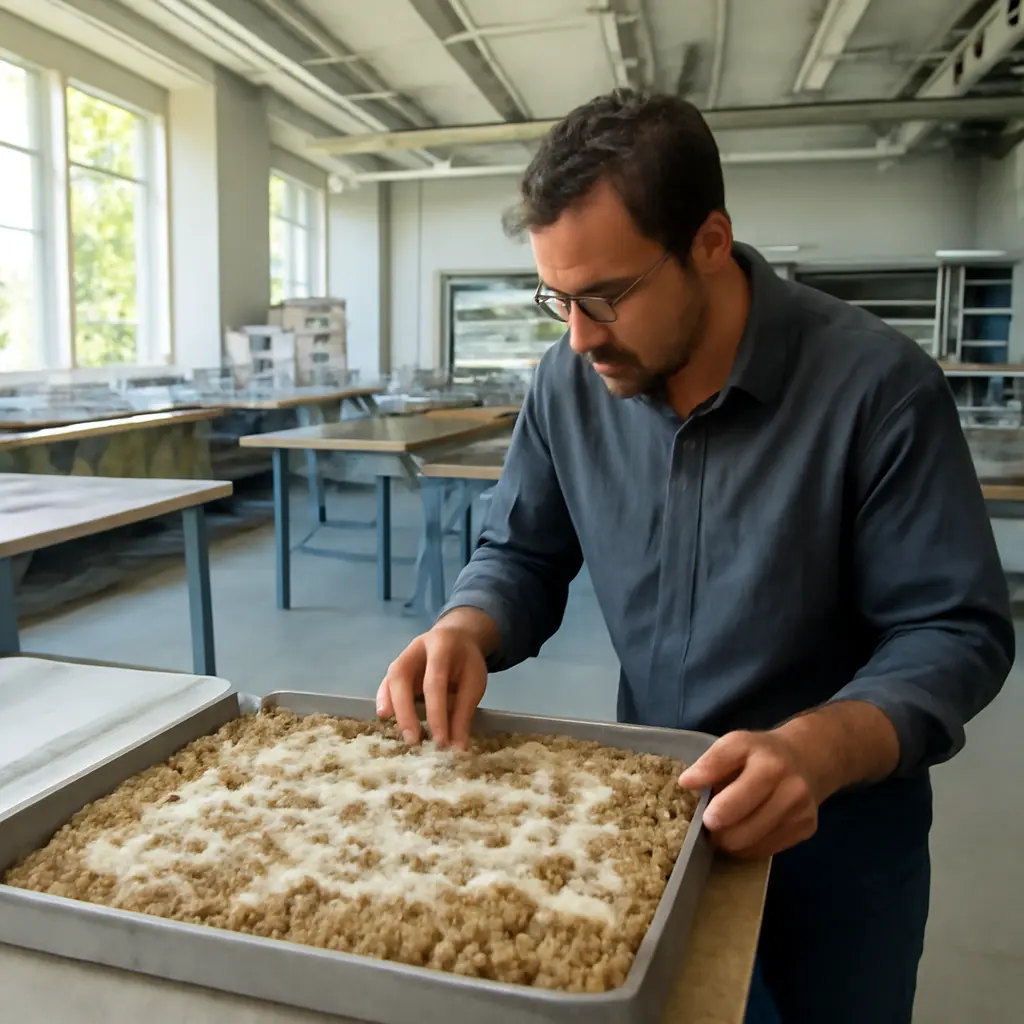
A practical validation plan samples multiple locations, including the centre, edges, corners, and thickest sections. Measure dry density as dry mass divided by measured volume, and report the mean alongside the standard deviation or coefficient of variation. Moisture content and local temperature records can help explain why a region differs from the rest.
Visual photographs can document surface coverage, but they cannot establish interior colonisation or material uniformity. Where appropriate, use cut sections, imaging, or destructive sampling, and compare mechanical properties across locations. State the sampling method and uncertainty so that apparent improvements are not overstated.
Use controlled design iterations
A controlled design iteration changes one major variable at a time—for example, vent layout, wall permeability, or cavity thickness—while keeping substrate and incubation conditions as constant as possible. Replicated moulds are important because biological growth varies between batches. A simple chart of density or moisture by sampling location can reveal gradients that a single average would conceal.
A useful comparison reports both overall performance and spatial variation. A mould may raise average density while worsening the difference between centre and edge; another may reduce variability without increasing the average. The preferred design depends on whether the product prioritises strength, insulation, dimensional consistency, low material use, or another specification.
Applications and practical design priorities
Mycelium composites are being explored for packaging, interior products, acoustic applications, and other lightweight components. Their appeal includes the use of biological growth to bind plant-based feedstocks, but performance and end-of-life outcomes depend on formulation, processing, coatings, and use conditions. A mould intended for protective packaging may prioritise repeatable cushioning and shape, while a panel may require consistent thickness and mechanical properties.
In all cases, begin with a simple, cleanable geometry and add complexity only when tests show a benefit. Rounded internal transitions, accessible filling, controlled vent placement, and repeatable demoulding are practical starting points. Evaluate the actual bio-based mould material under the intended moisture and incubation conditions, and document cleaning and contamination-control procedures.
Conclusion: design geometry, control biology, measure uniformity
Bio-based mould design can support more uniform mycelial growth density by controlling cavity thickness, gas exchange, wall properties, and substrate confinement. Yet geometry works in concert with substrate composition, moisture, packing, inoculum placement, and incubation. Research reviews identify these interacting variables as central to mycelium-composite outcomes, while also showing why a universal “best mould” cannot be assumed.
The practical next step is to establish a repeatable baseline, map conditions and material properties at several locations, and compare design changes using replicated trials. For further work, consult the mycelium-composite reviews listed below and report measurement methods alongside results. Doing so helps turn promising bio-based mould concepts into designs that are reproducible, fit for purpose, and easier to scale.
Sources: Jones, M. et al., “Mycelium Composites: A Review of Engineering Characteristics and Growth Kinetics,” Journal of Bionanoscience, 2017, https://doi.org/10.1166/jbns.2017.1440; Meyer, V. et al., “Growing a Circular Economy with Fungal Biotechnology: A White Paper,” Fungal Biology and Biotechnology, 2020, https://doi.org/10.1186/s40694-020-00095-z; Haneef, M. et al., “Advanced Materials From Fungal Mycelium: Fabrication and Tuning of Physical Properties,” Scientific Reports, 2017, https://doi.org/10.1038/srep41292.
Related Posts

Inside the Growth Period That Turns Fungi Into Materials
Mycelium growth period is the controlled biological interval in which…

The Growing World of Mycelium Chairs Tables and Home Pieces
Mycelium furniture is a category of chairs, tables, lighting, panels,…
Mycelium Production Doesn’t Need Virgin Resources at All
Mycelium is the branching network of fungal filaments that can…